
By Dr. Gina Maccarone, MD, FACS, FAACS
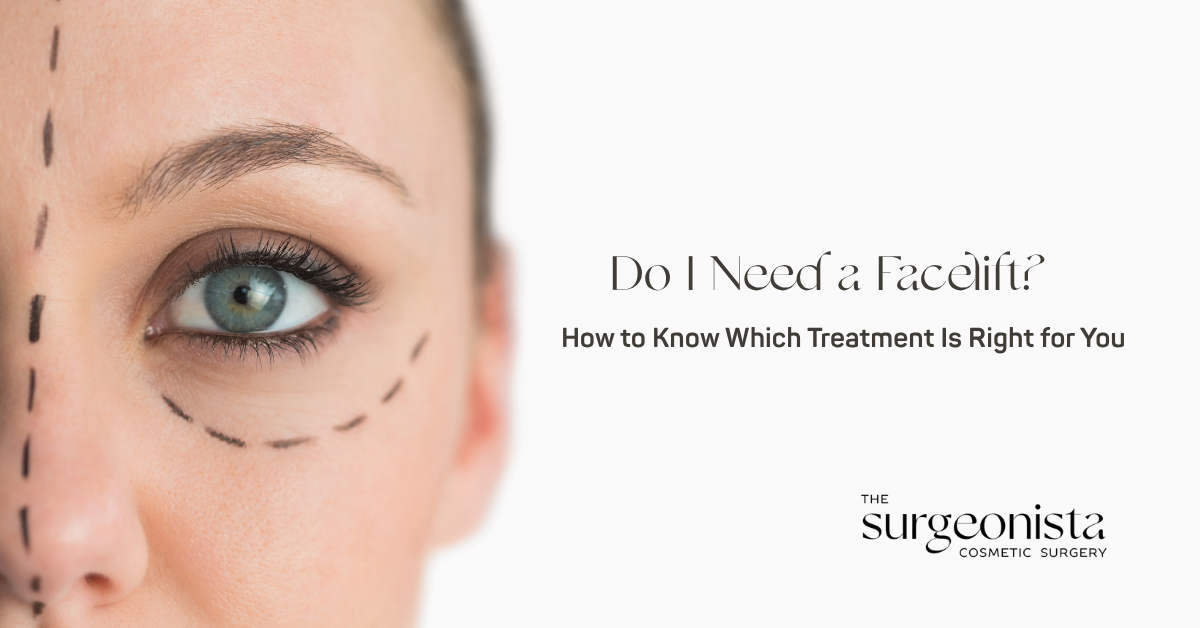
One of the most common questions I hear is, “Do I need a facelift?” The answer is: it depends on what’s actually causing the changes you’re seeing.
Many people assume that if they notice sagging, loose skin, or an aging face, a facelift is automatically the answer. But facial aging is more complicated than that. As we get older, our faces change in several different ways, and each change calls for a different treatment. That’s why the right answer isn’t always a facelift. It’s whatever treatment actually fits your face.
One of the biggest misconceptions about facial rejuvenation is that aging comes from one cause. In reality, it’s usually some combination of skin laxity, volume loss, changes in skin quality, and the natural shifting of facial tissue over time. Figuring out which of those is actually bothering you, and what’s causing it, is where the real work begins.
Sometimes It Really Is Skin Laxity
If the main concern is loose skin along the jawline, neck, or lower face, a facelift may genuinely be the best solution. It addresses tissue that’s descended over time, repositioning the deeper structures of the face, not just tightening skin. For the right patient, it’s one of the most effective procedures we have, because it treats the underlying cause instead of masking it.
Sometimes It’s Volume Loss
Other patients aren’t bothered by sagging at all. They’re noticing flatter cheeks, hollow temples, a face that just looks more tired than it used to. That’s often volume loss, not loose skin. In those cases, restoring volume, through fat grafting or injectables, can create a more refreshed look without surgery.
Sometimes It’s Skin Quality
Then there are patients whose real concern isn’t lifting or volume at all. Their skin just doesn’t look the way it used to. Fine lines, crepey texture, loss of elasticity. These can age a face even without significant sagging. For some of these patients, improving skin quality does more than a facelift ever could.
One option I discuss often is Renuvion®, a minimally invasive treatment that uses helium plasma and radiofrequency energy to tighten tissue beneath the skin. For mild to moderate laxity, it can improve firmness and definition without the recovery of traditional surgery. It’s not a replacement for a facelift when real lifting is needed, but for the right patient, it’s sometimes exactly what’s called for.
Sometimes It’s a Combination
Most often, the answer isn’t just one thing. A patient may have some laxity, some volume loss, and some change in skin quality, all at once. That’s why the goal is never to match a procedure to a diagnosis. It’s to find whatever combination creates the most balanced, natural result. I think social media has made this harder. We see a dramatic before-and-after and assume we need the same procedure. But a photo doesn’t tell you anything about that person’s anatomy, skin quality, or goals. Two women can look nearly identical in a picture and need completely different treatments. I don’t recommend a procedure based on a photo. I recommend it based on the person sitting across from me.
The goal is never to perform the biggest procedure. It’s to recommend the right one. Sometimes no surgery at all. The best cosmetic surgery isn’t measured by how much you’ve had done. It’s measured by how naturally the result fits who you already are.
Final Thoughts from Dr. Gina
When patients ask if they need a facelift, they’re usually asking a bigger question underneath it: what’s the best way to feel like myself again? The answer isn’t always surgery, and even when it is, it may not be the surgery they expected. Sometimes it’s something much simpler. A personalized consultation is how we figure out what’s actually causing the changes you’re seeing, and build a plan around that, not around a guess.
Xo,
Dr. G.